
AI Leadership Interviews · AI in healthcare and pharma
AI Must Be Human-Centered
Dr. Andrée BatesFounder and CEO, Eularis
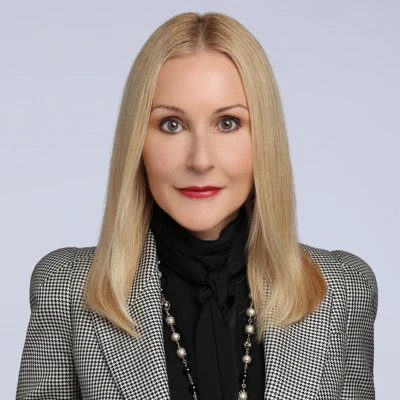
"When introducing AI, we must start with strategy, look at the whole business, identify problems, and see where AI might have the most significant impact.
AI should become a company-wide project, with the CEO involved and very aware. The financial impact should be substantial to excite the business about AI."
Dr. Andrée Bates , Chariwoman, Founder and CEO of Eularis , shared her key leadership insights and vision on AI in pharma in my "Leading Through Disruption" series.
Lauterbach: Could you please talk about your entrepreneurial journey and describe how you arrived at where you are today?
Bates: I started as a clinician, did a PhD in neuroscience, and worked in two hospitals in London. Back then, my research did not have any short-term real-world applications. For this reason, I moved into pharma just by answering an ad in the Guardian. Later, I was headhunted to Tokyo, then headhunted within Tokyo again. Several years passed, and I started my first digital health business in Japan. After that, I created my current company, Eularis to focus more on applying math to pharma challenges.
In 2003, Eularis helped commercial folks decode what needed to be fixed in their marketing. Marketers wanted transparency over parts of their spending efforts that led to the best outcomes. I started using mathematics but realized that linear math needed to be improved. During my PhD, I applied machine learning in our lab to validate neurological theories. So, I then applied ML to a commercial problem, running predictive algorithms to forecast how much market share was in flux in any given category and what brands needed to change in their sales and marketing (and channels) to grow. This methodology achieved around 94.8 percent accuracy on average across all brands. Then, I was approached to work on a project, which became a turning point in my career.
I was looking at an ultra-rare disease with an epidemiology forecast of 126 patients globally. In rare disease, your biggest concern is finding patients and looking at what works and what doesn't. The condition I was investigating was in children who were born with the condition. They needed to receive treatment very early on. If they didn't, they died before the age of 10 years.
While looking at the pictures of these children, I noticed that they all had very similar facial features. This led to a simple hypothesis. What if we put identified parameters into Flickr and Facebook? Could we identify photographs of children with the condition to enlarge the patient base? There was a big issue, though. How could we ensure we addressed relevant families without violating the privacy of so many? We decided to drop a cookie-similar technology to gather data on the search patterns of identified families. We were looking for images that matched the facial features recognition bot which could have indicated that the child had this condition.
One of the things we discovered is that children with the diagnosis had difficulty in potty training. Their IQ would also decline if they weren't treated quickly, and the impacted children often had runny noses. So we began to identify families searching for potty training tips, researching cognitive decline in children, and googling 'runny nose.'
With the methodology, we've quickly identified 13 new patients which doesn’t sound like many but the condition was extremely rare. We would do such a project differently today, but it was gratifying to think that 13 lives had been saved and these children would grow up to live a normal life. From then on, I wanted to focus on solving problems that had an impact. We changed the company's focus, still using machine learning and natural language processing and other AI techniques.
Nowadays, we work throughout the pharma value chain.
Years back, AI was not widely known. For example, when I said, "We use AI to predict market share," people responded, "AI, isn't that robots?" I remember attending a dinner party. Someone asked me what I did, and I said: "I work in AI and pharma." And they said: "That's very controversial." I asked why and heard back: "Artificial insemination is very controversial." So, the general population didn’t know what AI was. Even though AI has been around since the fifties or sixties, it has only recently moved into the mainstream.
Lauterbach: You started applying ML to solve problems before Big Tech became AI-centric, ImageNet was built, and Transformer architecture and GenAI were invented. When you think about your journey, what role did the human component play in introducing AI in businesses?
Bates: The human factor is, in many ways, the only part of AI that has problems. If you think about data choice, that's done by humans. It is all about ensuring fairness, representation, and diversity. And 'humans in the loop' means some things might be missing.
For example, there was a famous case with Amazon in around 2017. They used AI for recruitment and fed the database with great executives' resumes. They even started hiring some great people, but after a few months, someone noticed they needed to be new female hires. When they returned to check the database, they realized the only resumes they'd put in were male. So, they got rid of the gender field, but still kept hiring men. Ultimately, they realized that the language women and men used in their resumes differed significantly.
Data choice for model training is critical. The way we design AIs must be human-centered, and there are ethical considerations, too.
I saw a study from a law firm in Germany saying that automated decisions would be illegal if they impacted humans. In this context, AIs doing credit scoring for loans would become questionable.
Lauterbach: Please discuss your experience implementing AI in pharma. This industry is not young and is highly regulated.
Bates: I remember back in 2011, a CTO of a top-five pharma company came to me and said, "We want AI." I asked, "What do you want to do with it?" He was not sure. "What business units are you looking at?" He was not sure again.
When introducing AI, we must start with strategy, look at the whole business, identify problems, and see where AI might have the most significant impact.
AI should become a company-wide project, with the CEO involved and very aware. The financial impact should be substantial to excite the business about AI.
In pharmaceuticals, increasing efficiency is paramount. Speeding up drug discovery is an excellent example with measurable outcomes. But there are so many use cases throughout the value chain that we have implemented. Most fall into increasing efficiency or revenue growth.
Still, more education is needed as more business units see how AI augments human roles.
Lauterbach: What would you advise a CHRO of a traditional business to look at in the age of progressing AI?
Bates: I speak at some events every year, for example, at the Dean's of Business School Conference. I've noticed that they fear AI, especially around students cheating using ChatGPT. They were also trying to update their curriculum and had started looking at how to embed AI into their MBA programs and the majority doing that had ended up offering coding modules. That's not necessarily the right approach. Data scientists can do the coding. The MBAs should learn about what's possible in AI to connect the dots with the strategy rather than the nitty-gritty of coding.
I recently delivered a two-day masterclass for pharma executives. I saw that different ML methods could be explained very simply using apples and oranges.
Speaking simple language to describe AI is paramount.
One top 10 big pharma company have a full-blown AI unit wholly separated from the organization. No one knew what was happening there. People in the company told me it was very secretive and it was almost like an MI5 or MI6 unit, and no one in the company knew what they were doing and they didn’t communicate with the business teams at all. That is a bizarre approach. AI is there to help the business.
It is essential to highlight the benefits and success stories and break down the experience in case studies. Leadership is crucial, as it is up to leaders to address job security. AI augments humans; it doesn't eliminate jobs.
As for the story about deans of business schools, I like to remind them about the time when calculators were introduced. Educators worried that teaching math would become impossible. Calculators allowed us to do more complex math. So it's the same thing. AI enables us to do things better.
We also need to be educated in ethics and trust-building. Everything depends on who's in charge. It is essential to ensure that the company leaders are strong advocates for AI, can demonstrate it, and lead by example.
Lauterbach: What do you think about entry-level jobs in the context of AI delivering basic research better than humans?
Bates: The younger generation consists of digital natives. They grew up talking to Alexa and Siri. I am more worried about the resistant older generations because they don't understand AI.
Lauterbach: What is your vision of AI for the pharmaceutical industry?
Bates: Using AI for discovery, R&D, clinical trials, and market access could speed up a drug's time to market by 60 to 70 percent, cutting costs by 60 to 70 percent.
Clinical trials will be transformed due to digital twins and synthetic data.
Lauterbach: Could you please explain these two concepts to an audience that is not tech-savvy?
Bates: NASA invented digital twins in the 1960s to ensure solutions if something went wrong in space. The idea was to create an exact copy of a thing, work on it, and send up a fix. General Electric copied that and applied it to their power plants in the 1970s.
Today, in medicine, we have digital replicas of the organs in the human body. We've already had digital twins of hearts and pancreas for many years. There's a lot of impressive research on whole-body digital twins, and they are finding their way into clinical trials.
On top of that, we've also got synthetic data being used in clinical trials.
Synthetic data dates back to 2014, when Generative AI was invented by Ian Goodfellow, a British data scientist. He first created an algorithm to distinguish between real and fake data. To make it stronger, he designed a generator with an artificial neural network—a generative adversarial network—that took bits of the real and produced fake data. The result was so good that it was impossible to distinguish between the real and the artificial data.
Since October 2022, the FDA has approved clinical trials with digital twins and synthetic data.
There is already one example of a drug that had no phase one (testing on animals) and no phase two (testing on humans), because developers used digital twins. It is in phase three, with humans in the study and synthetic data in the control arm.
I know many people in the industry disagree with me on my next statement but I stand by it. I firmly believe that this technology will become even better, so eventually we won't have any animals or humans in any phases of clinical trials.
A while ago, I was speaking to a professor of biomechanics who was leveraging digital twins for testing drugs for pregnant women. She believes we would have digital twins for all of us within 10 years – potentially not in the EU, but in the US.
Finally, I predict that one day, pharmaceuticals will not have manufacturing units in a traditional sense. Instead, companies will supply ingredients, which will then be sent to the pharmacy to be 3D-printed based on a patient's digital twin data of how to personalize it for their unique biochemistry. We've already got 3D printers that are printing drugs and also capable of printing biologics so once digital twins get to the level of most people having one, no doubt this is the way the industry will go.
Personalization might impact further industries that are touching human health.
I've got a friend who is an architect in London. She is building homes with AI in the bathroom mirrors for diagnostics to identify micro-changes in the face and body that are indicative of specific conditions. They also have toilets that analyze urine and feces daily and both the mirror data and the toilet data feed into a dashboard with a picture of your health.No doubt this can also be linked to biotrackers as well such as watches.
Lauterbach: How do you assess AI opportunities in Europe compared to China and the US, which have adopted GDPR and the recent EU AI Act?
Bates: Emphasizing ethics is a double-edged sword, enabling a thoughtful approach to building AI but making it difficult to innovate due to data accessibility and freedom to test and pilot new models. We've got a pretty good collaborative ecosystem and a diverse talent pool.
Still, we need investment levels similar to those of the US and China. We need scalability because we've got market fragmentation due to different languages and various national regulations. We can't get medical records in some markets as quickly as in others.
The opportunities for Europe are to niche into AI areas with more freedom to do research and innovate on practical applications. As an example, Switzerland has impressive robotics. But the US and China will lead in AI.
Lauterbach: How can we ensure we build ethical and still practical AI?
Bates: About two years ago, I had Charles Radclyffe on my podcast. He had a company that scored the ethics of all companies in AI in all industries. His background was fascinating. He was a technologist, but he also had a degree in philosophy and law.
Lauterbach: So we are going back into the Renaissance and fusing STEMs with Humanities, aren't we?
Bates: Absolutely. Interdisciplinary education is all it needs.