
AI Leadership Interviews · Entrepreneurship and teams
Once You Stop Growing, You Start Dying
Andy EllwoodFounder and CEO, Stretch
Leading Through Disruption, #102
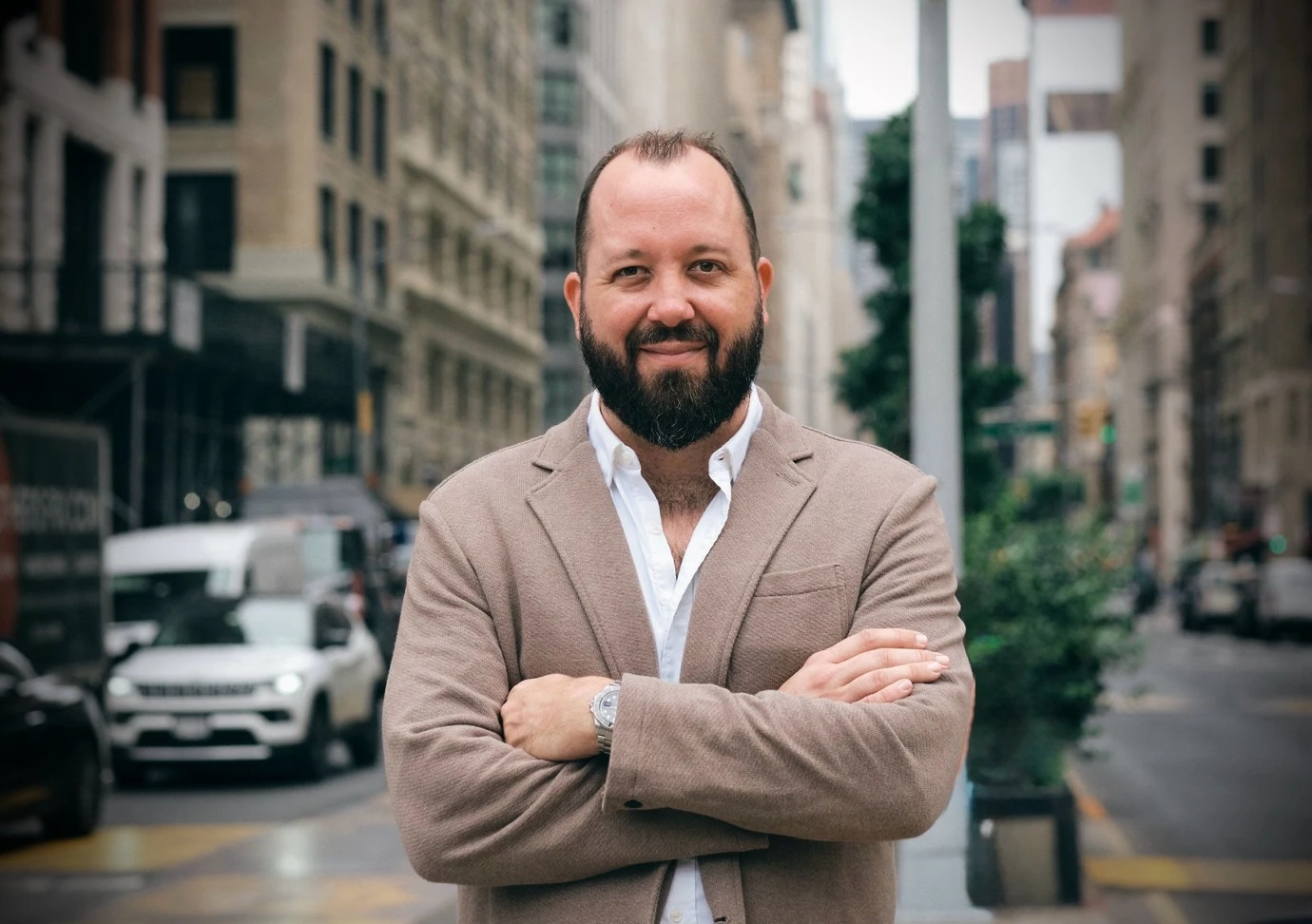
Andy Ellwood, founder of Stretch
Some founders fall in love with a solution. The rare ones fall in love with a problem - and stay faithful to it through a shuttered company, a pandemic, four years of deliberate distance, and a technological revolution that finally made the impossible possible.
I sat down with Andy Ellwood, a real force in the American entrepreneurial community. He was on the team at Waze when Google acquired it for a billion dollars, has been part of three acquired companies, built and closed his own grocery data startup, Basket, and mentored countless founders as an executive coach. Today he is building Stretch, a smart grocery shopping platform that tells families what their weekly list would cost across all the stores around them - an Expedia for groceries, if you wish. It matters more than it sounds. Grocery inflation in the United States has run over thirty percent since the pandemic, and one third of all food produced in the world is lost or wasted. We might feed the planet with what we throw away.
I spoke with Andy twice - once about his company, and once about the person behind it. His AI Snacks episode attracted 21 tsd listeners. Here, I am releasing our conversation about leadership: about curiosity as a career strategy, about non-negotiables, about grief after a billion-dollar exit, and about why wealth is best measured in options and choices.
I left our conversations thinking about human agency - a theme I return to constantly in my work on AI literacy. Andy's leadership philosophy is, at its core, a refusal to outsource agency: not to investors, not to circumstance, not even to the AI his team “speaks” so fluently. Control what you can control. Love the problem, not the solution. Define excellence and learn to measure it, before you delegate. And when success comes, make room for many. We cannot AI our way out of every problem - but leaders like Andy remind us that we were never supposed to. We are humans, and we should stay humans.
“The biggest flaw in most leaders is expectation-setting. Did you show your team what excellence looks like? Can you point at what it is about, and define how much time one has to reach it? Once that is defined, AI becomes a brainstorm partner and an asynchronous tutor that can skill a young person up to do things they've never done. I've been blown away by the younger people on our team - building entire systems by themselves with Claude as their tutor. The most exciting part is the self-reliance they gain through the process. They think: ‘I figured this out. What else can I figure out?’”
Andy Ellwood, Founder and CEO of Stretch, shared his thoughts on building companies to last, AI and high-performing teams in my latest "Leading Through Disruption" interview. Subscribe here to receive future interviews.
Lauterbach: Andy, you once described yourself as unemployable. Is that a floor to bounce from, or a ceiling not to reach after you exit a business?
Ellwood: I say it a little bit in jest, but once you've been a founder, it's tough to imagine not jumping back into the builder's seat. When I left my last company in 2021, I knew I would be pulled back - but I also knew I needed a break. Twelve years of building had exhausted me personally, spiritually and physically. So I became an executive coach. It kept me close to founders and founder problems, but I could sleep on weekends, get married, become a dad.
And I wrote down four non-negotiables - four things that would all have to be true at the same time for me to creage a new business, because I knew exactly what enterpreneurship costs a person and a family.
Lauterbach: Your daughter and your company are almost the same age. What does building a family teach a founder?
Ellwood: The best advice I got about becoming a dad came from another enterpreneur: you'll be great at it, because it's a lot like being a founder - as soon as you know what you're doing, what you're doing is no longer needed. My daughter proves it constantly. The moment I think I've figured out her routine, she matures and wants something new. It's the same in a startup: as soon as you get good at the early stage, you don't get to be in the early stage anymore. You have to grow into what comes next.
Lauterbach: You started your first business at twelve, and it kept running for years after you left. So many founders build to exit. What is your thinking on buisiness longevity?
Ellwood: You have to build with the expectation that it's forever. If you build with a short horizon, you make short-term decisions that might become an impediment later. If you build to last and somebody offers to acquire you, it is wonderful – a real privilege. But you don't have to take the offer, because you created something that could go on without. I want to build for the next decade. It will take at least ten years to make the impact I have in mind.
You have to be committed to the long haul to survive the short term. If you think it's a two-years thing, you'll quit. And once you stop growing, you start dying.
Lauterbach: What are your constants in building - the things that never change from one company to the next?
Ellwood: First, life's too short to work with jerks. Find people whose names you're excited to see pop up on your phone. And it's not about whether you could have fun with them - you can have fun with almost anybody. Is this the person you want to wrestle with? To be in conflict with and heal with? That's true in business, in friendship, in marriage.
Second: fall in love with the problem, not the solution. Especially now with AI, there are so many tricks you can perform - but if these don’t contribute to solving a problem of real people, nobody cares.
And third, curiosity. The only thing that doesn't change is that things change. Asking one more question, and maybe one more after that, has served me my whole life.
Lauterbach: How do you compose a team?
Ellwood: I want to be as hands-off as possible in the things I am not the best at. I'm not the best CTO, so I hired the best CTO. I'm not the best head of product, so I hired the best head of product.
The team of the future looks like this: people who are exceptionally good at certain things partnering with other exceptional people, AI doing the general work in the middle, and a group of young hustlers growing into excellence. An all-star, a bunch of AIs, and a protégé. You give your protégés just enough work beyond what they know they can do, and force them to grow into someone who can do more than they believed. Find their edge and ask for ten percent more.
Lauterbach: How do you develop people in the age of AI, when so much mediocre output can be generated at the push of a button?
Ellwood: Be crystal clear on the outcome and how they'll know they've reached it. The biggest flaw in most leaders is expectation-setting. Did you show your team what excellence looks like? Can you point at what it is about, and define how much time one has to reach it? Once that is defined, AI becomes a brainstorm partner and an asynchronous tutor that can skill a young person up to do things they've never done. I've been blown away by the younger people on our team - building entire systems by themselves with Claude as their tutor. The most exciting part is the self-reliance they gain through the process. They think: “I figured this out. What else can I figure out?”
Lauterbach: Building is tough, and some forces - wars, supply shocks, inflation - sit entirely outside a founder's control. How do you coach people through frustration?
Ellwood: Take a very good inventory of what you do control. There will always be things you cannot impact, and if you cannot impact them, they are not yours to carry. But it is up to you to decide how these things affect your business, and which levers make you more resilient.
You control your budget, your diet, your sleep, your deadlines, the expectations you set with investors, the signals you give the market. You control saying “I was wrong.” You don't control the closing of the Strait of Hormuz slowing fertilizer for American crops, but you do control putting a plan on the table and communicating what it means for your business. Owning what you can control is the best advice I can give.
Lauterbach: You define wealth in an unusual way. Tell me about it.
Ellwood: Wealth is about options. At every stage of life, the person with more options has accumulated more wealth. If you graduate with two job offers, you are wealthier than the person with one. Your network, your skills, your net worth buy you options for the moment you decide to take a big risk. When I face a decision, I ask: does this open options or constrain them?
Lauterbach: You have lived through three acquisitions. From the outside, each looks like triumph. What happens behind the scenes - is there grief?
Ellwood: All three were very different stories, but in each there was a feeling that we weren't done. When Waze sold to Google for a billion dollars, I was angry. If we had waited one more year, Uber would have paid five billion for an independent map. But I wasn't in the position to make that decision.
Selling a buisness is what happens when you raise venture capital. The day you take one dollar of outside money, the clock starts ticking: Your investors expect an exit. I don't take that lightly when I raise now. Every round is a little bit of control you give away. And yet, to build something of true significance, I believe you cannot bootstrap it - you cannot go fast enough alone. The sadness comes when the vision you were building becomes part of somebody else's bigger vision. You become the team implementing their idea, not the team designing yours.
Lauterbach: When is a founder done? Is a problem ever truly solved?
Ellwood: I've challenged our team with this question: what is a number outside our company that we want to see change? Not our metric - the world's.
Grocery stores throw away a hundred billion dollars of food every year because it never found a buyer. If we build a real demand signal - connecting the product that expires in three days with the family that wants it today - could we cut that from a hundred billion to fifty? A number like that is worth fighting for. Impact you can feel outside your company's walls: that's how I measure whether the work is done.
Lauterbach: Basket, your first grocery company, closed in 2021. Now you are back in the same arena. What did the failure teach you?
Ellwood: The grocery industry is antiquated, full of entrenched inefficiencies, because it works well enough for the people who run it. The data isn't structured, isn't machine-readable, and every store does things differently. With Basket, I got kicked out of retailers' offices when we asked to ingest their data. Our data model was an army of six thousand shoppers scanning barcodes in stores. When the pandemic confined everyone at home, that model died, and the company with it.
Here is the beautiful irony: the thing that killed Basket is what makes Stretch possible. The pandemic forced every grocery store to put localized pricing and inventory online. The data standards matured, and with AI we can now access and normalize what we never could before. After four years of not thinking about groceries, the door opened to serve those same families again.
Lauterbach: You speak about “making room for many.” What does it mean?
Ellwood: It comes from Ralph Waldo Emerson's essay “Power:” “There is always room for a man of force, and he makes room for many.” The people of force I know open doors not just for themselves but for everyone around them. Becoming a person of force resonated with me because it's not about what I can do for me. If I have some success, who else can I bring along? The more success, the more people. That's how I try to live - in the companies and communities I build and belong to.